

I didn’t own a copy of Madeline when I was a child.
In fact, I didn’t own many books growing up. I have a vague recollection of a few Little Golden Books, a full set of The Bible Story (likely gifted from a member of one of my dad’s many, many churches), and abridged versions of classics—like Black Beauty, Swiss Family Robinson, and Little Women—purchased from the Dollar Tree down the road.
We did, however, go to the library often.
An outing that didn’t require money, it was a no-brainer for my mom, a preacher’s trophy wife and a stay-at-home mom to five children. After being a SAHM myself for the last five years, I now understand, not just the want but the need, for public spaces like these, and have an even deeper appreciation of the absolute goldmine.
My earliest memories of the library include walking into that haven, smelling that distinct book smell, and feeling immediate peace—safety. I’d sit and read in a cozy corner for what felt like hours, then walk out with a torso-length haul of books and VHS tapes.
Thank God for books. Thank God for libraries. Thank God for my mom.
Books allowed me to escape from the unpredictable war zone that was my home, to charter new territories, to learn new languages, to be recognized and loved without the embarrassment and shame of physical onlookers.
Books were also my first teachers in code-switching.
And, the best part? They were free.
***
Recently, at bedtime, we’ve returned to Madeline, a children’s “classic.”
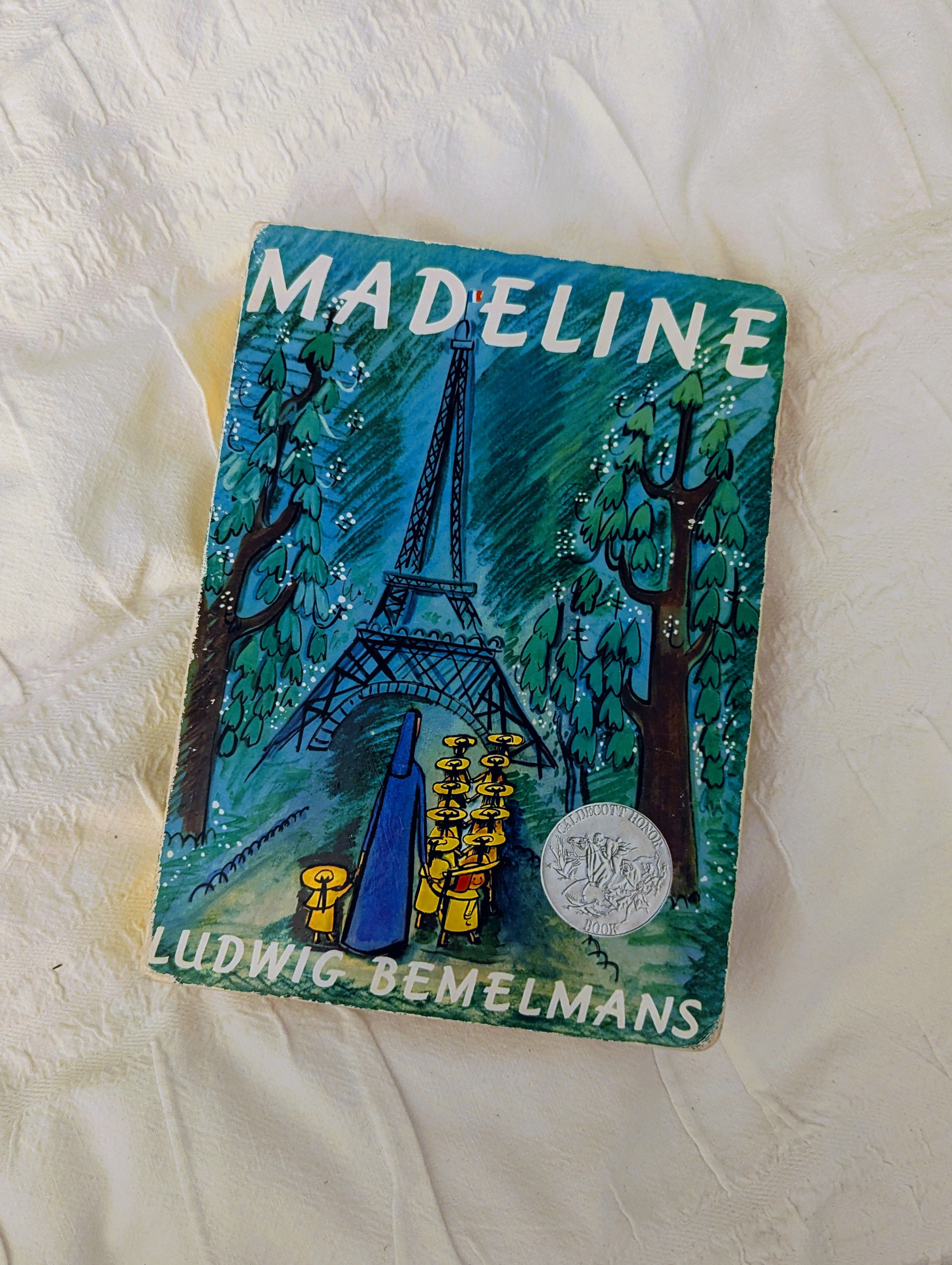
Six years ago, we were given the board book at our first daughter’s NYC baby shower. The gifters, our friends, sang its praises, recalling fond memories of their parents reading it to them at bedtime. I nodded along as though I could relate: “Ah, yes! Madeline! Thank you!” But it was all a ruse. I didn’t have the same connections that they had to the Parisian girl in that distinct, all-yellow uniform.
In that exchange, I remember wondering what it must have been like for them to be raised in, what I assumed, a financially-stable household with emotionally-stable parents. I’m sure they never worried if their parents were going to be able to pay all the bills that month. I’m sure they never worried if their peers were going to notice their secondhand clothing or worn, hand-me-down tennis shoes. I’m sure they never worried about whether or not they’d be moving before the end of the school year again and having to make new friends in a new place. I’m sure.
At least, at the time, I thought so anyway.
As you can imagine, I’ve done this often throughout my life—the lying. The nodding in agreement with familiar and unfamiliar faces in order to conceal my true identity: a poor girl from a poor family. Well-meaning people would say that I was a master in code-switching, or passing, or masking. Of course, the habitual lying only added to the shame that was multiplying in every direction beneath the surface, just under the fake agreement that was sealed with a convincing kiss, a beaming smile and artificially-lit bright hazel green eyes.
All I’d ever wanted—all I ever want now, for that matter—was to be safe.
***
When I became an adult, money and alcohol became golden tickets to that sought-after party. In our late 20s, my husband and I moved to NYC and attended our first Swanksgiving in 2015, the same year my 14-year-old brother took his life.
Swanksgiving was on the Friday night after Thanksgiving and was organized by our friends who, like us, were transplants from Austin, Texas. (Hook ‘em, horns!) Per the invitation, the evening of revelry required us to dress up in our fanciest clothes, which, for me, at the time, was a $50 dress off the sale rack at Anthropologie. We were instructed to meet up at various landmark bars across Manhattan and sip $25 stiff cocktails and mouthy red wines. We were told it would be delightful, and it was.
During that pre-kids chapter of our lives, Swanksgiving became one of those intoxicating kind of events, where, as Skye Sclera puts it, you desire the desiring—where you welcomed the notion of disappearing into a group of other aching human beings and, both individually and collectively, feel free from pain—if only for a night.
For our inaugural promenade, we started at the Roosevelt Hotel.
Erik and I had only moved to NYC the fall before, and I was still floating in the wake of my brother’s suicide. During the work week, I was buoyed by my job as a middle school English teacher and my husband, my anchor, while my family foundation started to disintegrate.
But, on that saccharine, silent night, I climbed my way out of our 500-square-foot cave in Sunnyside, Queens, to participate in the bright and shiny festivities, to dock on the shore of the Lotus-Eaters. I thought that, maybe, vanishing into the wealthiest rooms of the City That Never Sleeps would offer the elixirs I needed to forget home for one glorious and delicious night.
As we gallivanted from bar to bar—the Campbell at Grand Central Station, the Rainbow Room at 30 Rock, the Waldorf Astoria—we twirled, swirled, and skipped along urine-soaked sidewalks, arm in arm. We were a gleeful gaggle of bold-lipped women and suit-jacketed men, cosplaying as New York’s richest. In no time, I became emotionally and physically inebriated—numb, elevated, free.
It was working.
The Lotus-Eaters were too kind, serving up the delightful drug that temporarily suspended that magnetic pull home. In my mind, I was sailing farther and farther away from the nexus of pain that lived miles and miles away in an abode I barely knew anymore—or rather, that barely knew me.
There, in those places of grandeur and privilege, those historical hums of gold-plated portraits and dramatic landscapes, mahogany molding, shimmering chandeliers, leather-tufted seats, marbled columns, and cloth cocktail napkins, I was out of harm’s way.
So it seemed, anyway. And, well, that was the point, wasn’t it?
Nobody in those rooms needed or cared to know my origin story, about my brother’s recent suicide, or my family’s darkest secrets. No, they seemed to accept the lie just fine and be fine with it. I’m sure the surrounding merry-goers, however, quickly clocked who I monetarily was by the fast fashion I wore.
Nonetheless, I was in the room tonight, honey, not buried under a heap of blankets, contemplating the world’s existence, my own existence, with a mountainous pile of used Kleenex stacked on the old hardwood floors next to our bed. And: that’s all that mattered.
They were escaping, too.
By the time we got to Bemelmans, New York glowed like a Lana del Rey-Madonna figure: an illuminated, dense, haze cast over an industrial grid. We each coughed up the $25 cover charge at the door of the Carlyle with slight annoyance. The feeling quickly dissipated because, “We were young! We were free!”
With the other wives, I waited for my husband to deliver my next drink—my next ration of sweet, sweet Lotus. I pretended I was a young Sylvia Plath, sitting provocatively at the end of the bar adjacent to the hand-painted walls adorning the large, cozy room: scenes from Bemelmans’ Madeline. It felt strange to be an adult, downing alcohol, in a room full of children’s illustrations. And now, as a parent, it feels even stranger to think about that time and space—my mental space—surreal, even.
I’ve come a long way.
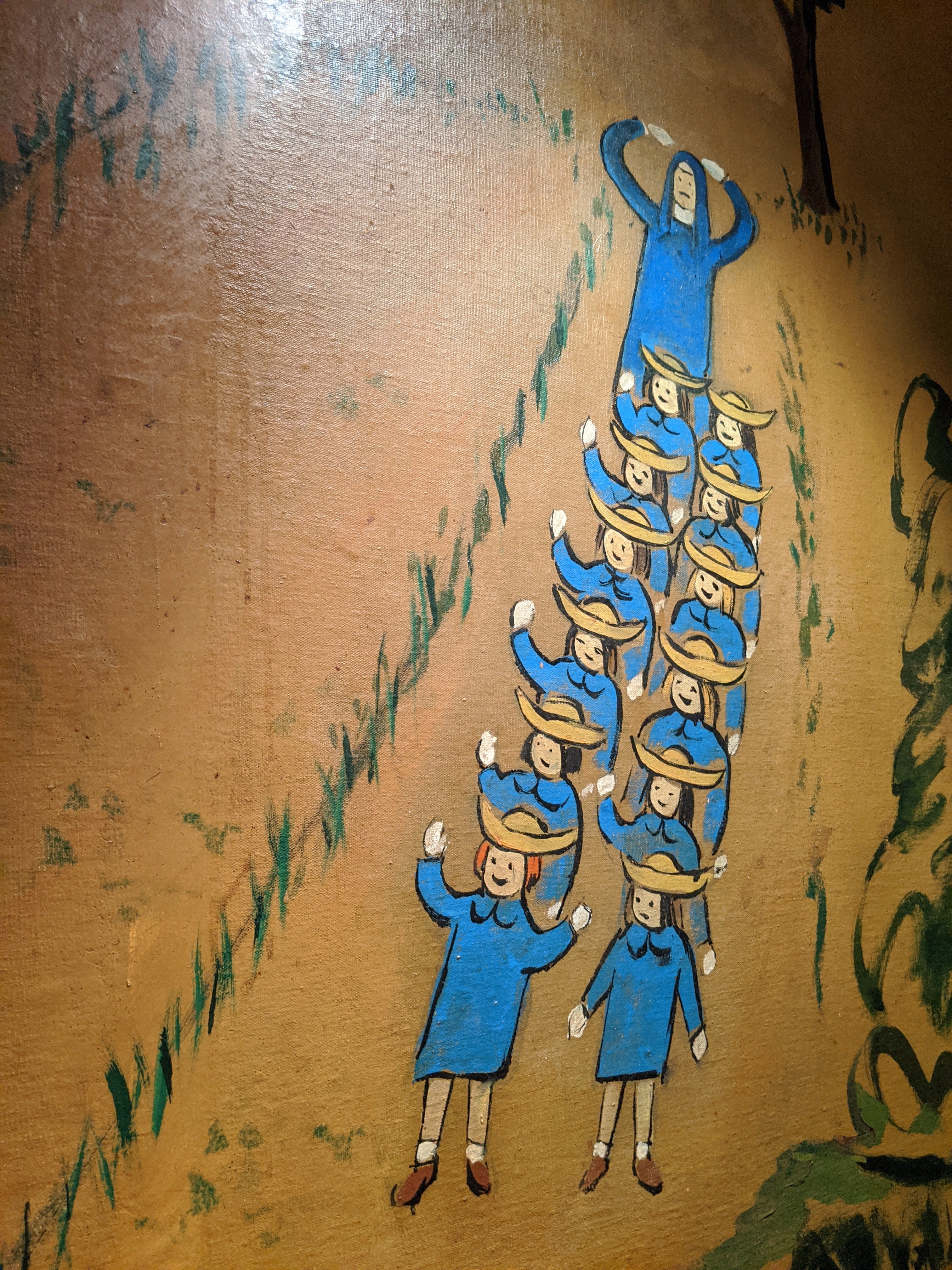
My band of happy humans exclaimed at the hand-painted scenes, pointing, shouting, waxing nostalgic about one of their favorite children’s books. And there I was, once again, unable to relate. Again, the lying. Shame gave her subtle tug, singing her siren song, beckoning me to get off that island of illusion, commanding me to return home. “No, Parthenope—not today!” I yelled in my sloshy mind, over-emphasizing the Southern accent that I was born with, that only makes an entrance when my biscuits are buttered. I was very good at this whole code-switching thing, a positive by-product of being a parentified child who grew up on food stamps and Medicaid.
Not a soul noticed my torment. Success.
I was indeed part of an “elite” group.
***
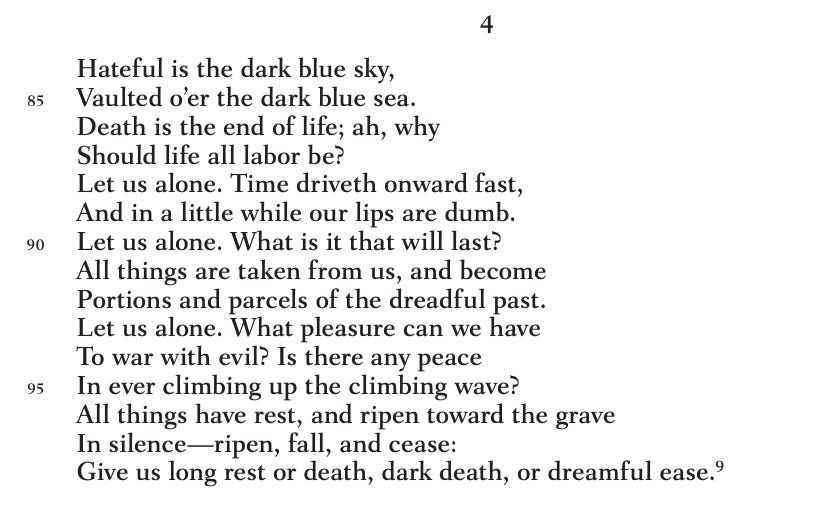
From “The Lotos-eaters” by Alfred, Lord Tennyson:
***
I didn’t know Madeline’s backstory until I started working on this essay. I only knew what the children’s book gives away—a little girl that belonged to a convent with eleven other little girls and a nun named Miss Clavel.
Bemelmans was a writer with his own demons, who enjoyed many visits with the Lotus-Eaters. However, his essential escape, where he’d come out the other side the most unscathed, was through the drafting of his Madeline series, inspired by his wife and his mother.
A little background: Bemelmans’ parents split when he was only six, and he quit school when he was just 12. His father offered him two subsequent choices: go to reform school in Germany (and likely end up fighting in a trench in WWI) or go to America. He chose America.
When his ship met Manhattan on Christmas Eve 1914, he was 16 and searching for a means to an end straight away. As WWI began, he joined the U.S. Army in 1917, teaching bayonet drill in upstate New York, then working in a hospital for veterans dealing with PTSD.
There, according to Jane Bayard Curley, a New York museum curator, the 17-year-old “had a nervous breakdown. He was all alone. He wanted to kill himself … He was terrified of failing. The things that kept him alive were what he called his ‘islands of security,’ these pictures in his mind, happy moments from his childhood. So he drew Madeline.”
On the subject matter, Bemelmans famously stated, “I have started to think in pictures and make myself several scenes to which I can escape instantly when the danger appears.”
Madeline likely saved his life. (Note: Isn’t it breathtaking how art saves lives—how art connects us to one another in a most sacred and metaphysical way?)
In 1946, he cut a deal with the Carlyle Hotel, offering to paint the walls of its new bar in exchange for 18 months of free accommodations for him and his family. The hotel agreed. And, by 1947, Bemelmans Bar officially opened—the same year that Bemelmans published Madeline.
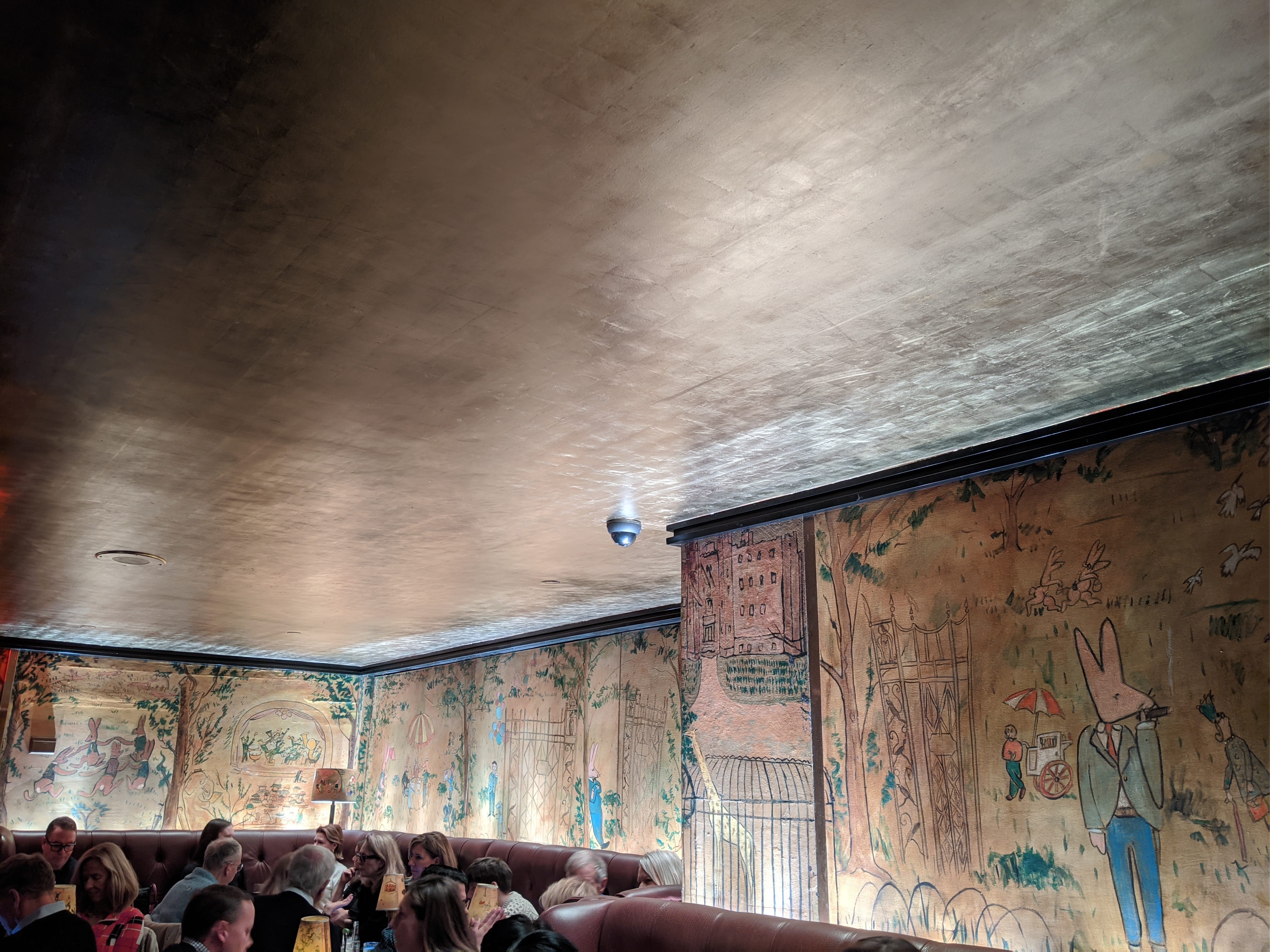
If you’re unfamiliar with the series, Madeline is about the experiences of Madeline and her roommates, her dear friends, without the oppressive eye of a parent: “They smiled at the good and frowned at the bad and sometimes they were very sad.” And, they loved her despite her unusual, precarious behavior—her “delight in mice; winter, snow, and ice; to the tiger in the zoo, she said ‘Pooh-pooh.’”
In other words, Madeline captures what makes life so worthwhile, so refreshing: human connection. The living alongside other human beings through pain and sorrow, through joy and happiness, through mundanity and divinity.
***
As we enter a new year, I’ve been thinking a lot about safety.
In early adulthood, I thought if I achieved financial stability, I’d be safe—free from triggers or traumas. Unfortunately, 20 years later, I’ve come to learn that this is simply not true.
Last May, on my birthday, I confessed to a couple of close friends that I felt guilty for all the times I had escaped either under the veil of grief or pain or human folly. Attentively, they listened and sympathized but also—like good friends—showed compassion towards me. They reminded me that we’re all just human beings doing our best, and they knew—because they know me—I had been doing my best all along, trying to swim in an impossible sea, attempting to find my way back home on an intense odyssey.
Upon further reflection, I now recognize those moments of escape, not as shameful lying or obscene myth-making, but as an essential role in the development of my story, my truth-telling.
I am who I am, and I am here because of having experienced there.
Homer and Bemelmans, both master storytellers, recognized this trait of the human condition—this desire to escape from one’s psyche—and did so through their art.
In addition, what I’ve found to be true is that a group of people—people with shared values and a shared goal—is how we create the safety net that we pine for, that we search for, that we go great lengths for—even resorting to lying for.
Yes, money provides a certain level of stability. Alcohol drowns out the noise for short-lived moments—often causing heaping damage to the body and to the mind. Neither, though, hold any real emotional value. Humans do.
Over my 38 years of life on this planet, books, friendship, marriage, and parenting have taught me these indispensable lessons—for better or worse.
One of the first phrases I whispered to my crying babies in the dead of night was, “You’re okay. You’re safe. Mama’s here. Mama’s got you.” I didn’t think about the power of those words then in my sleep-deprived stupor, but I understand them now when my daughters, 3 and 5, tell me why they love me, why they love their dad—why they feel safe in their home. And, I absorb their words, levitate, and think: This is it. This is everything. This is home.
In nearly every chapter of my life, I have been fortunate to have found safety net after safety net, to have found my people, in all of the possible and improbable iterations: a group of college kids barging their way into loud bars and raucous house parties, a clad of adventurous Austinites exploring music festival after music festival, a brigade of New Yorkers touring the city’s most historic bars, and now, here in Asheville, a wily neighborhood crew of parents and their offspring.
Safety nets are not woven by dollar bills or drugs; they are woven by human beings with shared values and a shared goal: to live alongside one another, to play, to indulge, to enjoy the ride and make damn sure we all find our way back home—safely.
Hey, y’all! Happy New Year! If you enjoyed reading this, might I invite you to:
Your support means the world to me and is how others find their way to this humble, little space! :) Thank you, and I hope you’re well!
Human/Mother is a publication designed for humans who are also parents and dealing with some pretty heavy life stuff. You can peruse, choose, and take what you need here.
“Books allowed me to escape from the unpredictable war zone that was my home, to charter new territories, to learn new languages, to be recognized and loved without the embarrassment and shame of physical onlookers.” Books allow us to live a thousand different lives - what a wonderful thing ✨
This is beautiful, Katrina. “I am who I am, and I am here because of having experienced there.” ~ perfectly said.