

“Which one would you like, Mama?” asks my four-year-old daughter as if she were reading off a script.
This is how imaginary play shows up these days in our home in the Appalachian mountains. “Hmm… That one,” I reply, and I point to the picture of a tube of fire engine red lipstick on the plastic Melissa and Doug styling menu. It came with the pretend make-up set she got for Christmas this past year.
The decision to buy her requested gift was a contentious one. Up until last December, I’d been strongly against purchasing items that placed high value or praise on external beauty. However, I wear make-up most days, and I recognize how my daughters often watch, completely captivated, as I apply a fresh face—a face that distracts from the less-than-pretty story underneath—using an array of ILIA products. Little scientists, my children observe every blush, every swipe, every glide, registering to memory the grooves of my skin, the cracks of my lips, the Braille of their mother, a woman they know intimately but yet do not know at all—not even close.
“How about this one?” my blonde beauty responds, completely disregarding my selection. She automatically picks up the soft pink lip gloss and begins “painting” my lips. There’s something about her delicate, focused movement that moves me. Something about locking my hazel eyes with her hazel eyes. Something about being the person that is the reason behind her beaming smile. Something about witnessing her sheer delight in the activity and connection with the body that made her—the body that now holds her in her arms. I start to weep at the miracle of it all, catching my ugly reflection in the mirror of the caboodle beside us. My daughter’s unfazed. She’s too wrapped up in the moment that oozes love; she’s not yet clued in on the magnitude of the collision actively happening in my prefrontal cortex—how mothers and daughters and mirrors hold an interconnection that both breaks and binds us. It’s a tale as old as time.
My mom always wore a lot of makeup growing up. After all, she was a product of the 80s with big jet-black curls, big brown eyes—big glam. I remember watching her from the bathroom door, just like my daughters now watch me, totally mesmerized, noting her pauses, her motions, her breathing—the silent language that told me everything I needed to know about the dissatisfaction and disgust she had with herself.
While my four-year-old proceeded in her play, I started thinking about the personal essay imitation I wrote this past summer in Rachel Howard’s memoir writing class at Stanford.1 It was based on Grace Paley’s “Mother.” I started thinking about how funny it was that my child imitated my mother with such precision, unknowingly, in her blatant rejection of my want—of my need. I started thinking about the twinge of anger I felt in that moment and how the feeling quickly dissolved into a strong, sweeping sadness—a longing for that familiar closeness, a desire for that first home.
***
“My Mom”
One day I was listening to Cyndi Lauper radio on Spotify. My daughters were running through the sprinkler on a perfect summer’s day. The song “True Colors” came on. Jesus Christ! I cried listening to the lyrics of that song. I have often longed for my mom to see herself in the mirror—to see her true colors. As a matter of fact, she spent a lot of time looking at herself in the mirror when I was growing up. She stood one day, just so, in the master bathroom, the darkness of the bedroom behind her. It was her thirtieth birthday. I was thirteen. She said sternly, “You can’t have a boyfriend until you’re 16. If you don’t wait, well, you don’t know what’s gonna happen.” She laid out this new rule with an authoritative tone. She had begun the work. She would not let her daughters end up like her—not if she had anything to do about it, she thought. So she demonstrated.
At the changing room mirror at Belk’s department store she said, “You never wear dresses. You look so pretty in dresses. Put your hair down around your face, like this. There, you see? Perfect.”
Another time she was looking at herself in the mirror, getting herself all done up for date night with our dad. I had just threatened to never give her another dime of my own money—ever again! How could she allow that sorry, good-for-nothin’ husband of hers, whom she chose to marry and stay with, who didn’t have the balls to ask his own eighteen-year-old daughter for money, to control her? He sent her to do the begging. He always sent her to do the begging—for the rent, for the light bill, for the phone bill, etc. She stood, applying the last few strokes of waterproof mascara, tears rimming her eyes but never escaping. She was hard that way. She shouted: “OK, Katrina! I won’t. I won’t ever ask you for another dime—ever again!”
I wish she could see herself in the mirror.
One fateful night, my family’s two-bedroom condo—just three miles from the crashing waves of the Atlantic—was reeling like a taut and overextended fishing line. The atmosphere wasn’t dissimilar to that Saturday morning two years prior when my mom found her one and only son stone-cold in his closet—forever 14. Yes, that morning and this night had similar qualities, namely the fracturing.
There, in the area between the kitchen, the living room, and the girls’ bedroom and bathroom, my mom was anchored, facing my dad, her husband, with a balled fist and a barbing pointer finger. She’d just learned of (or rather heard) his costly misstep: he had knocked on my two youngest sisters’ shared bedroom closet just moments ago, calling out my dead brother’s name (who of course was not there but rather six feet under in my Granny’s family cemetery forty minutes inland). “Preston? Preston?” he inquired with a wild, deranged look in his eyes.
Then she shattered.
She burst, “I am no longer your wife! I do not love you! I have not loved you for years!” For the first time, they saw one another, bare. It was not like that first night after their courthouse wedding when they were 16 and 18. My parents both stood there while my middle sister wildly opened and closed drawers in the kitchen, like a possessed savage, searching for the sharpest knife—the one that Mom had bought from Goodwill and boasted was “basically brand-new.” Then my mom told my dad to get out and never come back. She said to him, “I will not allow you to hurt our children anymore.”
“You’ve hurt me for the last thirty-two years, M—, and I am done. We are done. I don’t ever wanna see your ugly face—ever again! Do you hear me?!” she roared. My middle sister then screamed a scream that refracted a lived history of horrors from the “fun” house of our youth, and he ran out the front door, yelling something about how the van was in his name so he’d be coming back to take what was rightfully his.
Then she shattered.
***
Reflexively, since becoming a mother myself, I have longed for my mom to see herself in the mirror, not only in the mirrors of her new home with her new husband but in all of her daughters’ homes—in my youngest sister’s coastal college dorm room; in the starter home my middle sister bought with her husband off Highway 707; in my other sister’s sage-doused abode in Boone; and in my own family’s bungalow nestled in the beautiful Blue Ridge Mountains surrounded by life-giving greens and assuaging blues.
I couldn’t articulate it as a child, but I have longed for my mom to see herself in the mirror, to see herself honestly—a beautiful, flawed human being—and, though I have avoided the mirror myself for years, unable to face the truth of who I am and where I come from, I can now look at myself in the mirror and see myself clearly, see the full spectrum of my true colors: the vibrant and the dull and grey. And, I can love myself and hold both the pleasing and the unsightly pieces of my very being—of my overall makeup.
I can smile at the almost 40-year-old woman, who, with her devoted husband, is building a loving, stable, and safe home for her children. I can marvel at the darkened circles around her eyes, the newly-formed wrinkles that appear on her face, and the defined stretch marks across her midsection. I can appreciate this image, the image that her daughters see on the daily—an untouched but very much worked image—and it is this image that they will carry with them for all the rest of their days. It is this image that they will cling to the fragments of, and see reflected in their own mirrors—and, potentially, in their own children and in their children’s children and so on and so forth.
I’m sure a wide range of human emotion will continue to develop and become attached to this recurring image. But, among and above them, I hope they feel immense pride.
I hope they feel endless love.
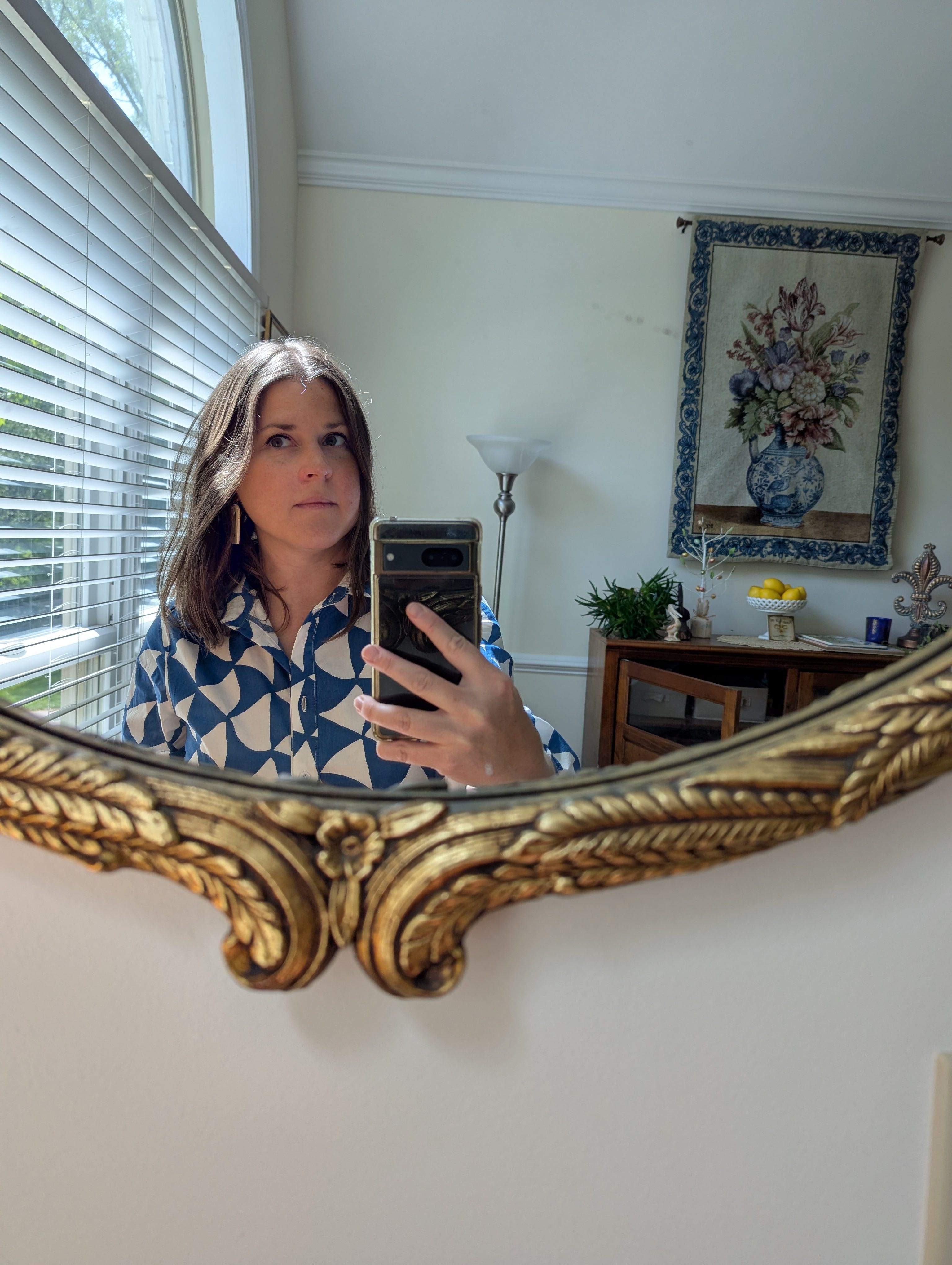
Holy guacamole! It’s been two years since I gave birth to Human/Mother. Time flies when you’re having fun, huh? Thank you for being here. Thank you for reading my words. Thank you for your encouragement.
Human/Mother is a publication designed for humans who are also parents and dealing with some pretty heavy life stuff. You can peruse, choose, and take what you need here.
Big thanks again to Evelyn Skye for selecting me as one of the winners of her Mid-Career Writing Scholarship last year.
Your mother’s experience reflected on alongside your own is both poignant and encouraging. Well-told, thanks, Katrina.
A beautiful, gut wrenching piece. Thank you for your honesty .